
The Rotary Club of Enfield is honoring Enfield’s veterans by sponsoring military tribute banners that will be displayed in Higgins Park, the Town Green, Freshwater Walkway, North Main Street and Hazardville between Memorial Day and Veterans Day in 2026 and 2027. The Enfield Public Library partnered with Enfield Rotary to preserve digital versions of these banners as well as biographical information about each veteran.
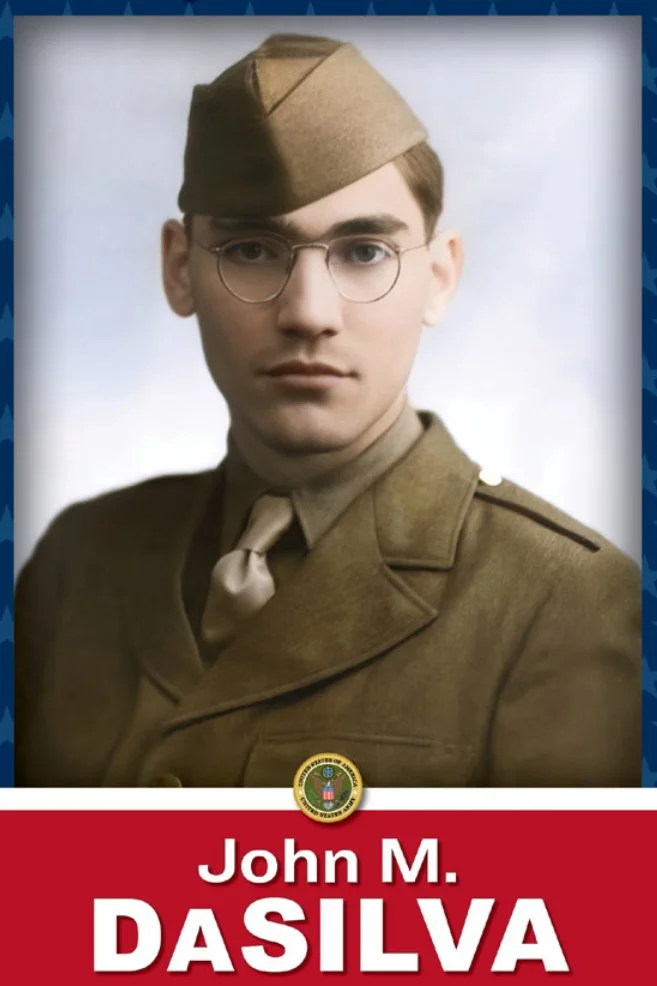
john m. dasilva Sr.
United States army 1942-1946
world war ii
technical sergeant
Army Record of John M. DaSilva, Ser. 32679592
(Originally Written by John M. DaSilva, SR. himself. Edited by his daughter, Pat)
John M. DaSilva, SR. was inducted into the United States Army by the Draft Board at White Plains, NY on December 9, 1942. He left White Plains by rail for active duty on December 16, 1942 and he arrived at Fort Dix, NJ the same day. After being processed for clothing and equipment and having a physical examination, he remained there for two weeks since they did not have combat boots to fit his foot size 13B.
After being equipped with combat boots, he left in a railroad coach train with many inductees, traveling west toward Chicago and then south to Fort McClelland, AL. He was assigned to Company A, 25 Battalion, Captain Zimmerman commanding, for thirteen weeks of infantry basic training.
Prior to one week’s completion of basic training, the Red Cross advised him that his brother had been taken prisoner by the Africa Korps, a German panzer division commanded by General Rommel. Rather than take his furlough and start basic training over, he elected to stay and finish his basic training.
Subsequently, he was shipped out and reassigned for duty at the Embarkation Army Post Office in Grand Central Station in New York City. His duties consisted of sorting mail for the troops in the European Theatre of Operations, the troops were billeted at the Breslin Hotel on 29th Street. This assignment, while allowing him to go home to White Plains frequently, entailed many overtime hours of work. Daily, he and others would march up First Avenue to 45th Street and as they crossed 42nd Street, people would wipe tears from their eyes, thinking the men were going overseas. John always felt bad about this.
In June of 1944, John asked for a reassignment, and he was reassigned to the 99th Army Postal Unit that was forming in Fort Monmouth, NJ, which was a signal corps training camp. They formed to service mail for the 99th Infantry Division, a crack army unit whose ranks were subsequently decimated in the Battle of the Bulge. Because of a snafu involving the acquisition of their operating equipment, John and others never caught up with the division. The army postal unit that took their place lost nine of the group when they were sent up to the front lines in the Battle of the Bulge.
In December, the equipment to operate an army post office was completed, including distribution cases, etc., two vehicles, a 4X4 truck and a jeep. John and others were taken to New York harbor where they were loaded onto a refrigerated United Fruit Line ship carrying two million pounds of meat and butter for the troops in Europe. They were assigned two men to a stateroom, and there were only ten army personnel on board besides the crew. They anchored in New York harbor for several days, while a convoy was forming. They then weighed anchor and steamed north through Cape Cod canal, finally anchoring in Boston Harbor, while the rest of the convoy formed.
Finally, on December 16, 1944, the convoy left Boston to cross the Atlantic. The convoy traveled at about eight knots an hour, protected by destroyers and frigates to ward off the Germain U-Boats. After a voyage of 19 days marked by many incidents involving the dropping of depth charges, they arrived at Birmingham, England, where they debarked and were assigned to work at the First Base Post Office.
In March, John and his mates left England to set up their operation, stopping enroute at Camp Twenty Grand near the small village of Duclair, France. They left this point in the latter part of March 1945, driving through France and Belgium and arriving in Bonn, Germany on April 8, 1945, where they set up their first post office in Euskirchen, Germany. Subsequently, they occupied the civilian German post office in Bonn, Germany, servicing a variety of troops. After the German surrender in June 1945, they were selected to redeploy to Asia Pacific Operations through the United States after 30-day furloughs.
They traveled back through Belgium and France, arriving in Camp Lucky Strike, Le Havre, France for redeployment to the United States. Eventually, they boarded the troop ship, Lejeune, which was converted from the captured German supply ship to the German pocket battleship, which was scuttled by the Germans in Montevideo, Uruguay.
John and his mates left France on June 18, 1945 and he arrived at Boston, Massachusetts Harbor on June 26th. The Lejeune carried 8,000 troops.
After 30-day furloughs John and his mates reassembled at Indiantown Gap, PAfor redeployment to the far east. They transferred to Camp Stoneman, CA and were there when the war with Japan ended. Subsequently, John was transferred to take charge of the 9206th Technical Service Unit. This unit processed mail for servicemen returning to the United States form the American Theater of Operations (ATO). The ATO represented the domestic defense and administrative, training, and mobilization zone, rather than a primary front-line combat zone.
On February 20, 1946, John was separated from the Service at Camp Beale, CA. He returned to work at the White Plains, NY Post Office on March 25, 1946.
John married his wife, Marie, on October 23, 1948. They had four children, all of whom grew up in Enfield and still live in the Enfield area. John’s family has grown to eight grandchildren and now, nine greatgrandchildren. His wife, Marie, also still lives in Enfield at the age of 98. John passed away on July 21, 2013, at the age of 94.